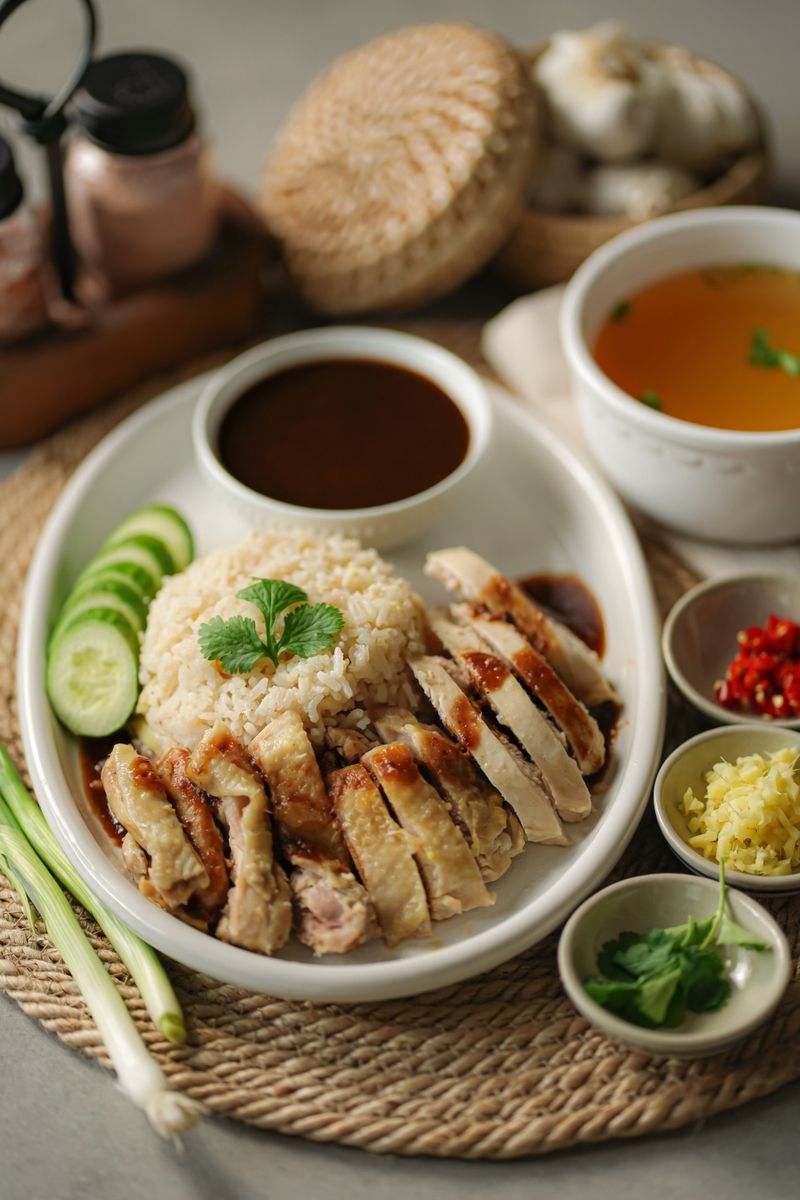
How Many Calories Are in Chicken Oil Rice? How It Compares to Plain Rice
AI estimate: the chicken oil rice on one plate of Hainanese chicken rice (about 1.5 bowls of cooked rice) is about 350–420 kcal, roughly 100–170 kcal more than the same amount of plain white rice.
If you eat chicken rice and can't tell how much the oily rice adds over plain white rice, that gap is the number to look at. Chicken oil rice is made by stir-frying rice in rendered chicken fat and then cooking it in chicken stock, so the grains soak up the fat. That extra 100–170 kcal is bigger than the gap between skin-on and skinless chicken (about 80–100 kcal), and bigger than the cucumber, clear soup and sauce put together.
The rice on one plate of Hainanese chicken rice vs. plain white rice (AI estimate)
| Item | Portion | Calories (Bao AI estimate) |
|---|---|---|
| Chicken oil rice | About 1.5 bowls cooked (the rice on one plate) | 350–420 kcal |
| Plain white rice | About 1.5 bowls cooked (same amount) | About 250 kcal (the figure on our Hainanese chicken rice page; no published value to check it against) |
| Chicken oil rice minus plain rice | — | About 100–170 kcal (same page) |
| Whole plate of Hainanese chicken rice (chicken and sauce included) | One plate | 550–700 kcal |
The chicken oil rice, plain rice and gap figures all come from the AI estimates on our Hainanese chicken rice page. We found no published plain-rice value to check against, and we did not add or subtract anything ourselves. How much a bowl of cooked rice weighs also varies by shop; the "1.5 bowls" is the figure from that earlier page. Hong Kong's Centre for Food Safety lists a whole plate of Hainanese chicken rice at 201 kcal per 100 g, with 22.7 g of carbohydrate and 9.3 g of fat, which gives a way to cross-check: a 300 g plate (our assumption) comes to about 600 kcal, in line with the 550–700 kcal range for the whole plate.
Whole plate of Hainanese chicken rice: two sources side by side
| Source | Figure | Whole plate |
|---|---|---|
| Bao AI estimate, per serving | One plate | 550–700 kcal |
| Centre for Food Safety, per 100 g (via Bowtie) | 201 kcal, 22.7 g carbohydrate and 9.3 g fat per 100 g | About 600 kcal (converted using our assumed 300 g plate) |
What moves the number
Two things: how much cooked rice is on the plate, and how much chicken fat went into it. A shop with less rice and less oil lands toward the 350 kcal end, and a shop with a big, glossy mound lands toward 420 kcal. The roughly 250 kcal for plain rice is also just an estimate from that same page, so treat the 100–170 kcal gap as a direction, not a weighed result.
Ordering it lighter
Asking for less rice does more than any other swap. If you want the chicken-fat flavor without the extra kcal, split one plate of rice between two people or eat half of it. Bao looks at the photo for the golden sheen on the rice and does not score it as plain white rice.
Common questions
How many calories are in chicken oil rice? The chicken oil rice on one plate of Hainanese chicken rice (about 1.5 bowls of cooked rice) is about 350–420 kcal. That is an AI estimate of a common range, not an exact count. Bowl size and the amount of oil differ from shop to shop.
How many more calories does chicken oil rice have than plain white rice? About 100–170 kcal more for the same amount (AI estimate). The gap comes from the chicken fat and the stock, and it is bigger than the gap between skin-on and skinless chicken (about 80–100 kcal).
Does swapping to plain white rice cut a lot of calories? Swapping to plain white rice saves roughly 100–170 kcal, the biggest single change on the whole plate. Rice portion and oil vary a lot from shop to shop, so this is only an estimate.
Why does chicken oil rice have more calories than white rice? Chicken oil rice is made by stir-frying rice in rendered chicken fat and then cooking it in chicken stock, so the grains soak up the fat. For the same amount, that comes to about 100–170 kcal more than plain boiled rice (AI estimate).
Sources
- All figures are AI estimates, not exact values. The chicken oil rice, plain rice, gap and whole-plate figures come from the AI estimates on our Hainanese chicken rice page (the 2026-11-01 version).
- Centre for Food Safety, Hong Kong, per 100 g (via Bowtie, read 2026-11-01): Hainanese chicken rice. The 300 g plate is our assumption.
Stop guessing your macros
Bao gives you honest nutrition estimates for the food you're actually eating.
Download on the App Store