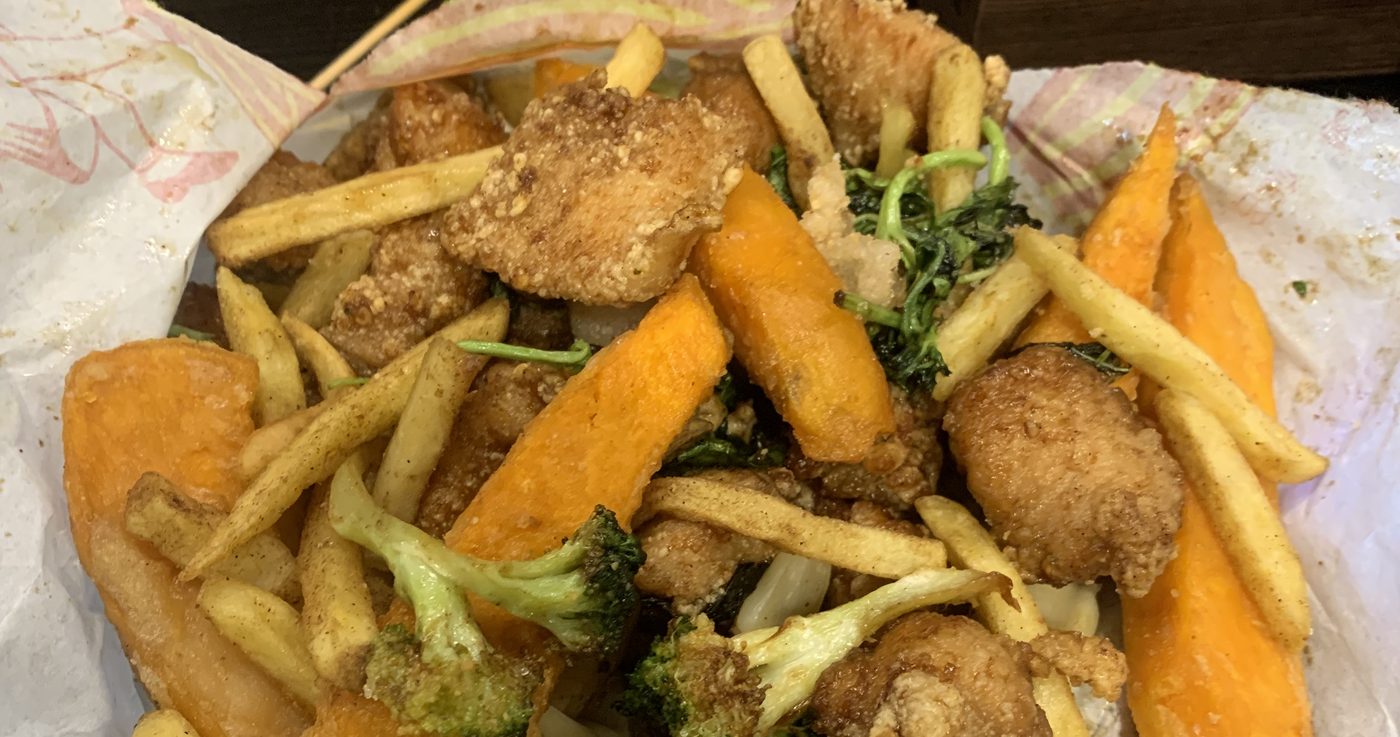
How Many Calories Are in a Fried Chicken Combo with Fries?
At a Taiwanese fried chicken stall you do not order a dish. You take a basket, point at whatever is behind the glass — chicken, fries, sweet potato, a handful of vegetables — and it all goes into the same fryer and comes back in one paper bag. There is no menu, no portion size and no label. Most people count the chicken, decide it was the expensive part, and stop there. The chicken is not where the surprise is.
One real basket, scanned: 900 calories
| Item | Calories | Share of basket |
|---|---|---|
| Fried chicken (popcorn chicken style) | 540 kcal | 60% |
| French fries | 216 kcal | 24% |
| Sweet potato fries | 130 kcal | 14% |
| Broccoli | 14 kcal | 2% |
| Total | 900 kcal | 100% |
That is one real basket Bao scanned at a stall counter, itemized piece by piece. It came back at 42g protein, 80g carbohydrate and 47g fat, with sodium around 1,200mg. These are AI estimates from a photo, not lab figures — the point of the breakdown is the shape of the meal, not the last ten calories.
The sides nearly double the chicken
The fried chicken is 540 calories. Everything else in the basket adds 360 more — a 67% increase on top of the thing everyone assumes is the whole problem.
Two of those additions do all the work. French fries at 216 and sweet potato fries at 130 come to 346 calories between them, which is more than three-quarters of what a whole extra portion of chicken would cost. They go into the basket almost as an afterthought, because they cost a fraction of the chicken at the counter and they take up less room in the bag.
The takeaway: at a fried chicken stall, the chicken is the decision people make carefully and the sides are the decision they make in two seconds. The sides move the total by 360.
The 60/40 shape
| Group | Calories | Share |
|---|---|---|
| Fried chicken | 540 kcal | 60% |
| Everything added alongside it | 360 kcal | 40% |
On this basket the chicken is 60% and the additions are 40%. That is a ratio worth carrying to the counter without any app at all: a fried chicken order is roughly two-thirds chicken and one-third everything else, and the "everything else" is the part that changes basket to basket. A second starchy side is not a small adjustment to the order — it is close to a third of it.
The practical version: the number of fried items in the bag matters more than which fried items they are. Swapping regular fries for sweet potato fries moved this basket by 86 calories. Leaving one of them out entirely would have moved it by far more.
The vegetable is 14 calories
The broccoli in this basket came back at 14 calories — 2% of the total, and genuinely close to nothing even after a trip through the fryer, because a few florets weigh very little and broccoli has almost no starch to soak oil into.
That is useful in both directions, and it is worth being precise about which. Adding a vegetable to a fried basket does not meaningfully raise the number, so there is no reason to leave it out. It also does not lower the number, because nothing in the basket gets removed when something else goes in. It is a fibre and micronutrient decision, not a calorie one — and at a counter where everything is priced and served together, those two questions feel like one question.
What the ratio can't tell you
The 60/40 shape tells you where to look. It cannot tell you what today's basket actually weighs, and at a stall that is the entire problem. 540 calories of chicken assumes the scoop you were handed. A heavier scoop, a thicker starch coating, or oil that has been running hot all evening and pushes the same chicken well past 600.
Coating and oil are the two biggest levers and neither is visible on a receipt. A thin, crisp coating in fresh oil absorbs noticeably less fat than a thick batter in oil that has been reused since opening. There is no label to check and no serving size printed anywhere. The only thing that reflects the basket in front of you is the basket in front of you.
Common questions
How many calories is a bag of Taiwanese fried chicken on its own? A standard bag of 鹹酥雞 — roughly 150g of chicken, no sides — generally runs 490 to 610 calories depending on the coating and the oil. The 540 in this basket sits right in the middle of that range. We break the chicken down on its own in our 鹹酥雞 guide.
Are sweet potato fries lower in calories than regular fries? In this basket, yes — 130 against 216 — but that gap is mostly portion, not ingredient. Sweet potato and potato are close enough per gram that once both are deep-fried, whichever one you got more of is the higher number. Treating sweet potato fries as the light option is a habit worth checking rather than assuming.
Is 鹹酥雞 the same as 雞排? No, and the difference matters for counting. 鹹酥雞 is bite-size chunks fried loose in a bag; 雞排 is one flattened breaded cutlet, usually 600 to 650 calories on its own. See the 雞排 breakdown for that one.
Does adding a drink change much? More than most people expect, and it is the one item that never gets counted because it is not food. A canned beer or a sweetened tea alongside a basket like this can add 150 to 250 calories — comparable to the entire sweet potato fries portion above.
How Bao handles it
Bao itemizes a fried chicken basket from one photo, so the fries get their own line instead of disappearing into a single number. That split is the whole point: a total tells you the basket was 900 calories, but only the breakdown tells you that the two side items you barely thought about came to 346 of them.
Stop guessing your macros
Bao gives you honest nutrition estimates for the food you're actually eating.
Download on the App Store