How Many Calories Are in a Slice of Pizza?
Pizza has a reputation for being unknowable, and it does not deserve one. A slice is a fixed object with four things on it, three of which are the same on every pizza in the world. The reason pizza is hard to count has nothing to do with the food. It is that nobody orders one slice, and almost nobody writes down how many they actually had.
So, the short answer: a standard slice — one eighth of a 14-inch cheese pizza — is about 285 calories. Pepperoni takes it to roughly 300. That is the headline answered. The rest of this page is about the four things that move that number, in the order they actually matter, and about the arithmetic that decides how a pizza night lands.
Typical calories per slice
| Slice | Serving | Calories |
|---|---|---|
| Thin crust, cheese | 1/8 of a 14" pie | ~200–230 kcal |
| Vegetable or margherita | 1/8 of a 14" pie | ~230–280 kcal |
| Cheese, regular crust | 1/8 of a 14" pie | ~285 kcal |
| Pepperoni | 1/8 of a 14" pie | ~300 kcal |
| Meat lovers or supreme | 1/8 of a 14" pie | ~320–380 kcal |
| Deep dish or stuffed crust | 1 slice | ~380–480 kcal |
| Frozen supermarket pizza | 1/3 of a pie | ~350–400 kcal |
These are typical published figures for a standard American-style pie, not any one chain's current menu. Where a restaurant publishes its own numbers, those beat a table on a website — including this one.
Four things move the number, and the topping is last
1. Diameter, and it is not linear. Pizza is sold by width and eaten by area, and area goes up with the square of the radius. A 14-inch pie has about 36% more pizza in it than a 12-inch. Both get cut into eight slices, so both hand you a thing called "a slice" — one of which is a third bigger than the other. This is the single largest variable on the page and it never appears on a nutrition chart, because charts are per slice and slices are not a unit.
2. The crust. Thin crust takes roughly 60 to 80 calories off a slice before anything else changes. Deep dish and stuffed crust add more than any topping decision available to you on the same menu.
3. The cheese. On most slices the cheese is the second-largest line after the crust, and extra cheese is on the order of another 50 to 70 calories a slice.
4. The toppings, last. Vegetables cost close to nothing. Pepperoni and sausage are oil, and they are the only topping decision with real weight behind it — which still puts them fourth.
The order is the useful part. People negotiate the toppings and accept whatever size arrives, which is exactly backwards. Ordering a 14-inch instead of an 18-inch changes more than every topping swap on the menu put together.
One real slice, itemized
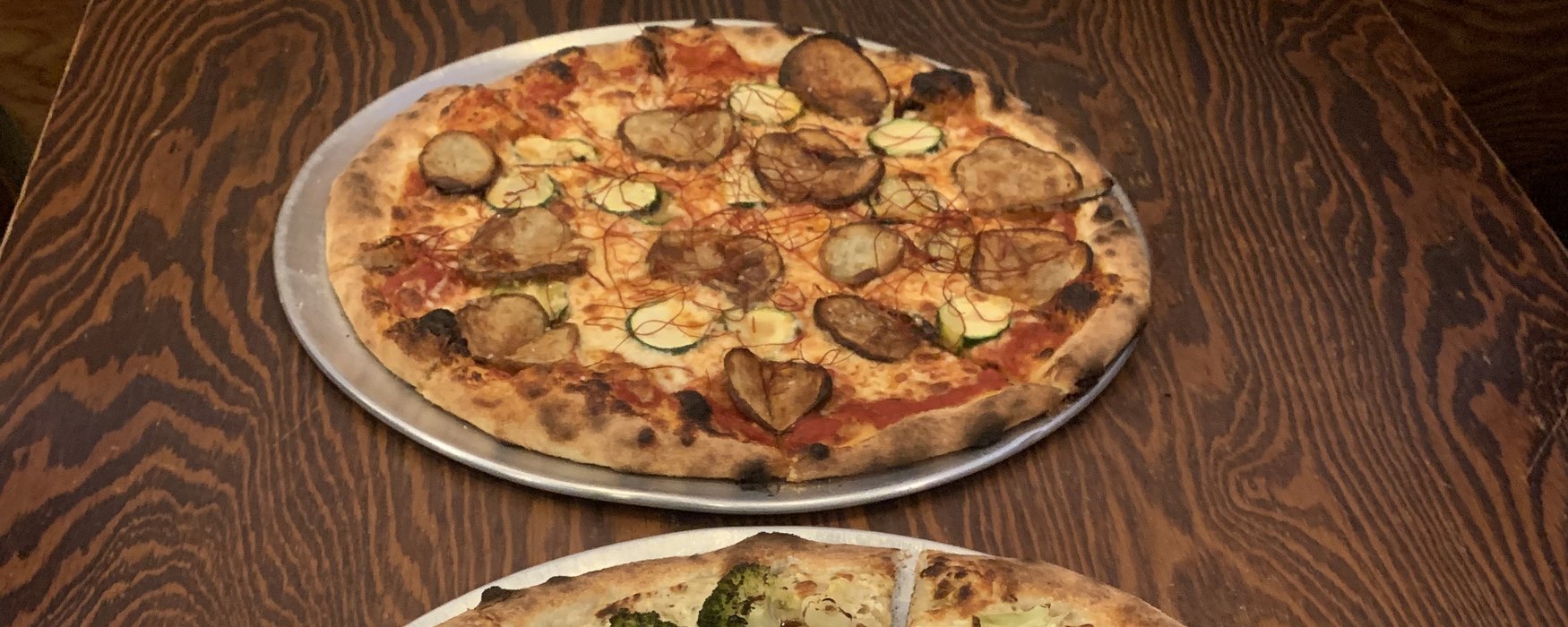
Here is an actual scan rather than a chart: a white pizza slice with broccoli, Brussels sprouts and balsamic glaze, photographed at the table it was eaten at. The app broke it into six lines.
| Line | Calories | Share of the slice |
|---|---|---|
| Pizza crust | 180 kcal | 47% |
| White sauce | 80 kcal | 21% |
| Cheese | 60 kcal | 16% |
| Broccoli | 25 kcal | 7% |
| Brussels sprouts | 20 kcal | 5% |
| Balsamic glaze | 15 kcal | 4% |
| Total | 380 kcal | 15 g protein · 40 g carbs · 18 g fat |
Two things are worth pulling out of that. The crust alone is 47% of the slice, before a single topping is discussed. And both vegetables together came to 45 calories — less than the cheese, and a quarter of the crust. Add the balsamic glaze and everything sitting above the cheese is still only 60. If you have ever wondered why a vegetable pizza is not a light meal, that is the answer, and it is sitting underneath the vegetables.
The 380 is an AI estimate from one photograph, not a nutrition label. It is higher than the 285 in the table above because it is a larger, loaded slice with a sauce on it, which is precisely the kind of gap a generic chart cannot tell you about.
Two pizzas on the table, one of them yours
The number that ruins a count is almost never the slice. It is the gap between what got ordered and what got eaten, and that gap is invisible if you log the order instead of the plate.
While we are on the subject of ordering, one piece of arithmetic worth carrying around: a single 18-inch pizza contains about 12% more pizza than two 12-inch pizzas. Two boxes look like more food than one box. They are not. "We got two" describes the receipt, not the portion.
The practical version is dull and works: count the slices you take, not the pies that arrive. Four slices of a shared 14-inch is roughly 1,140 calories on the cheese figure above, and it is a real number whether or not anyone writes it down.
Pizza after a workout
Training does not change the arithmetic. What it changes is what you want the meal to do, and after a hard session that question is about protein, not about permission.
The itemized slice above carried 15 g of protein for 380 calories — respectable for pizza, and still under what a post-training meal usually wants. The move that helps is additive rather than subtractive: two slices plus something with protein next to them does more than three slices does, at a similar total. Pizza is a carbohydrate and fat delivery system with a modest amount of dairy protein along for the ride, and it is easier to add to than to argue with.
Common questions
How many slices are in a pizza? Eight is standard for a 14-inch, but six is common for a 12-inch and some places cut ten. Every per-slice figure on the internet assumes eight, so check the cut before trusting one.
Is thin crust always lighter? Per slice, yes — reliably, by 60 to 80 calories. The catch is arithmetic rather than nutrition: lighter slices are easier to have four of.
Does blotting the oil off actually do anything? A little, and there is a hard ceiling on it. A teaspoon of oil is about 40 calories, and a napkin does not lift a whole teaspoon. It is a real reduction and a small one; do not build a plan on it.
Is pizza bad for you? It is bread, tomato, dairy and whatever is on top, which describes a great many meals nobody worries about. It is calorie-dense and usually high in sodium, and it is eaten in multiples. Those are the three real properties. None of them is a moral one.
Why do two apps give me different numbers for the same slice? Because a photograph cannot see the diameter it was cut from, and neither can a chart. Any honest estimate for pizza is a range, and the useful thing an app can do is show you which line inside the slice is doing the damage.
How Bao handles it
Bao photographs the slice and itemizes it — crust, sauce, cheese and each vegetable as its own row, which is the table further up this page. That breakdown is the point. A single number tells you a slice was 380 calories; six rows tell you that 260 of it was crust and sauce, which is a thing you can act on the next time you order.
You can also correct the portion before it is logged, and on pizza that matters more than almost anywhere else, because "a slice" is not a unit and Bao cannot see the pie it came from. Adjust it, log it, and the day's total goes on being true.
Stop guessing your macros
Bao gives you honest nutrition estimates for the food you're actually eating.
Download on the App Store