How Many Calories Are in Thai Food?
Thai food has one of the widest calorie ranges of any cuisine you can order from a single menu. A som tum lands near 120 calories. A plate of pad thai can clear 900. And the same three words — "green curry chicken" — can mean 324 calories or nearly double that, depending entirely on whether the rice underneath it got counted as part of the dish or as its own line.
That last part is the reason a dish name alone can't answer the question. Below is one real Thai lunch scanned item by item, followed by the typical ranges for the dishes most people actually order.
One real Thai lunch, scanned: 1,103 calories
| Nutrient | Amount | % Daily Value |
|---|---|---|
| Calories | 1,103 kcal | 55% |
| Protein | 63 g | 126% |
| Carbs | 133 g | 48% |
| Fat | 36 g | 46% |
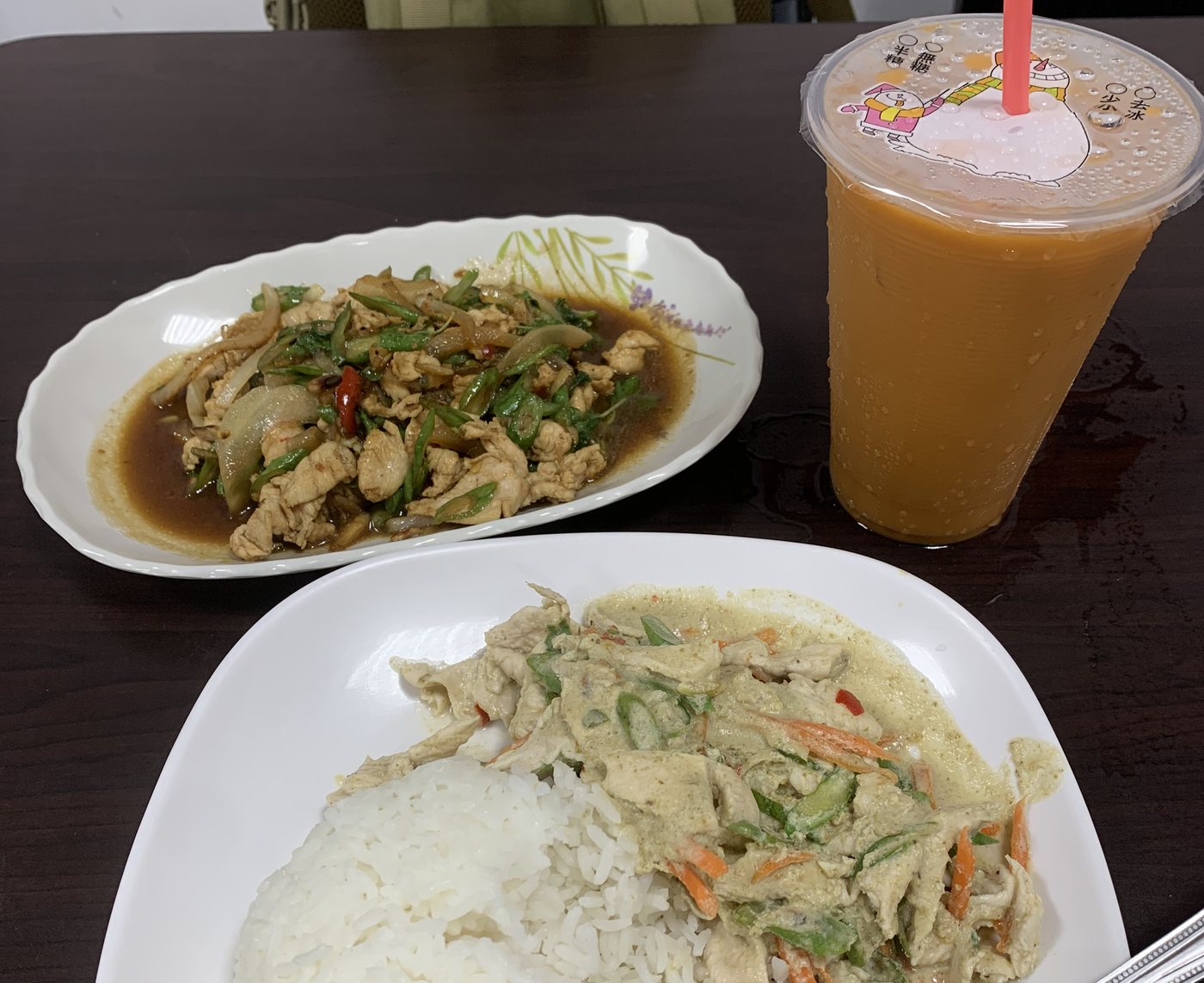
This is a real table Bao scanned from a single photo at a Thai eatery — two plates, a bowl of rice and a drink, itemized in one pass. It is a full lunch for one person, not a tasting spread, and it is a fairly ordinary order. Calories here are AI estimates from that scan, not lab measurements.
Where the 1,103 calories come from
| Item | Calories |
|---|---|
| Thai green curry chicken | 324 kcal |
| Stir-fried chicken with basil | 288 kcal |
| Thai iced tea | 275 kcal |
| White rice | 216 kcal |
The iced tea outscored the rice
The drink is the fourth line on that list and the third-largest number on it. At 275 calories, the Thai iced tea beat the entire bowl of white rice by 59 — and it beat it while being the one item on the table nobody thinks of as food.
Thai iced tea earns that number honestly. It is black tea plus sweetened condensed milk plus evaporated milk plus sugar, and the condensed milk alone runs about 60 calories per tablespoon. Published figures for a standard 16 oz serving generally land between 240 and 300 calories, so 275 sits right in the middle of the expected range rather than at the extreme of it. A boba-shop version with tapioca pearls goes higher still.
The takeaway: if you are estimating a Thai meal in your head, the drink is the line most likely to be missing from your estimate — and it is rarely a small one. Ordering the same meal with water instead takes roughly a quarter of the calories off the table without changing a single thing you eat.
Why "green curry" has two different calorie counts
In the scan above, the green curry chicken is 324 calories — the curry itself, with the rice counted separately at 216. Look up "green curry" in most nutrition databases and you will get a number closer to 550–650, because the reference serving those databases describe is green curry over rice, as a single plated dish.
Both numbers are correct. They are answers to two different questions. This is the single most common reason a Thai meal gets mis-estimated: the dish is counted once as a curry and the rice is counted again beside it, or the curry-with-rice figure is used and the separate bowl of rice is added on top of it. Either way the total moves by 200+ calories.
The same trap sits under pad kra pao. Ordered as it usually is — minced or sliced meat over rice with a fried egg — published figures run to roughly 650. The stir-fry on its own, without the rice and egg, is closer to 260–400, which is where the 288 above comes from.
Typical Thai restaurant servings
| Dish | Typical serving | Calories |
|---|---|---|
| Som tum (green papaya salad) | 1 plate | ~120–190 kcal |
| Tom yum soup | 1 bowl | ~180 kcal |
| Thai iced tea | 16 oz | ~240–300 kcal |
| Green curry, curry only | 1 cup | ~250–350 kcal |
| Mango sticky rice | 1 serving | ~450 kcal |
| Green curry with rice | 1 plate | ~550–650 kcal |
| Pad kra pao with rice and egg | 1 plate | ~600–700 kcal |
| Pad thai | 1 restaurant plate | ~600–900 kcal |
These are typical ranges compiled from published nutrition data, not measurements of any specific restaurant's cooking. Real plates vary with oil, coconut milk, sugar and portion size — three tablespoons of wok oil is about 350 calories on its own, and nobody measures it. Treat the ranges as a starting point and the wide ones as genuinely wide.
The same table, scanned twice, two macro splits
Bao scanned this table twice — once with the app running in English, once in Chinese. The calorie figures agreed exactly: 324, 288, 275, 216, totalling 1,103 both times. The macro split did not. One scan returned 63g protein / 133g carbs / 36g fat; the other returned 56g / 129g / 39g.
That is a useful thing to know about every AI nutrition estimate, not just this one. Total calories are the most stable output because they are the most constrained — the individual macros have more room to move while still summing to the same total. If you are tracking calories, the number is dependable enough to act on. If you are tracking protein to the gram, treat any single photo estimate as a close approximation rather than a reading.
Common questions
Is Thai food healthy? The cuisine has genuinely light options — tom yum, som tum, grilled proteins, steamed fish — sitting on the same menu as coconut-milk curries and deep-fried noodle dishes. There is no single answer for "Thai food"; the order is what decides it.
What's the lightest thing to order? Tom yum and som tum are the two reliable ones, both usually under 200 calories. Adding a protein to a papaya salad still keeps most versions under 250.
Is green curry or red curry lower in calories? They are close. Both are built on coconut milk, which is where most of the fat lives, so the curry paste color matters far less than how much coconut milk the kitchen uses and whether it arrives over rice.
Does the fried egg on pad kra pao matter? It adds roughly 90–120 calories depending on how much oil it was fried in — enough to notice, not enough to be the reason a plate cleared 650.
How Bao handles it
Bao itemizes what it can see in the photo and gives each thing its own line — including the drink, which is the line most often left out of a mental estimate. When a curry and its rice arrive as separate items, they are counted as separate items, so the total reflects what is actually on the table rather than a database's idea of a standard plate.
Stop guessing your macros
Bao gives you honest nutrition estimates for the food you're actually eating.
Download on the App Store