How to Split Calories on a Shared Plate
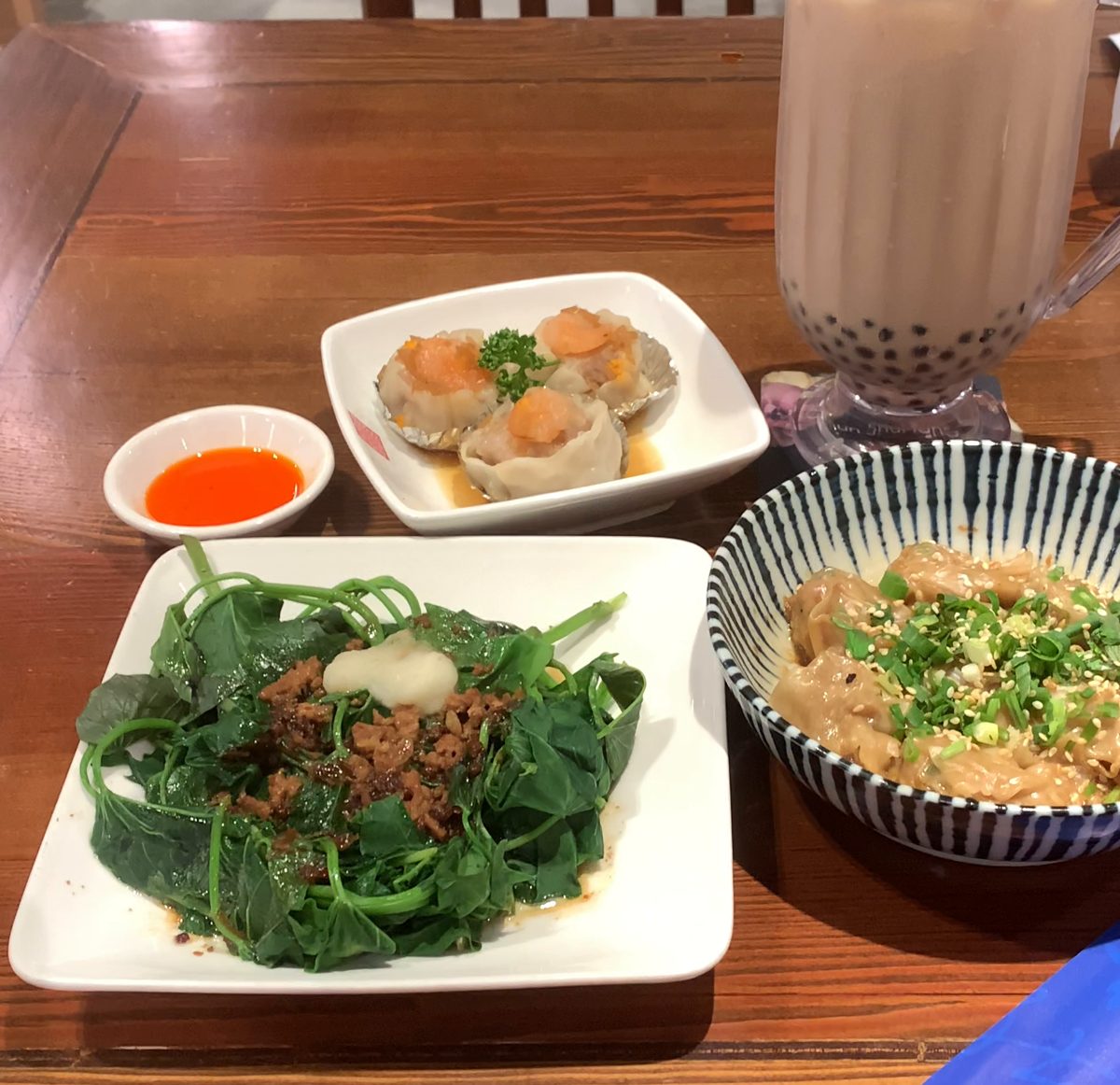
Family-style meals break every calorie tracker. Four dishes land in the middle of the table, two people reach for all of them, and nobody owns a plate. Logging "dinner" as one entry overcounts you. Logging nothing undercounts you. This post covers three honest ways to split a shared table, when each one fits, and a real example scanned from one photo.
The problem: nobody owns the plate
Most calorie tracking assumes one person, one plate, one entry. Sharing breaks that on purpose. The siu mai arrives as a plate of three, and nobody can cut a dumpling in half politely, so the portions are already uneven before the first bite. The drink is the same story in reverse: it is one big glass, and it is the largest number on the table.
Three honest ways to split a shared table
1. Split evenly by headcount. Log the whole table, divide by the number of people, and log your share. This fits when everyone picks at everything in roughly equal amounts, which is most shared tables. It is fast, and it is wrong in small, forgettable ways.
2. Split by the share you actually took. If you ate most of the noodles and your friend finished the greens, an even split hides that. Log the whole table once, then adjust the portion on the dishes where you clearly took more or less than half. This fits when you remember who ate what, and it takes about a minute longer.
3. Log only your own portions. Skip the whole-table entry and log just what you put on your own plate. This fits buffets and hot pot, where you serve yourself and there is no obvious "whole table" to scan. It is the most accurate method on paper and the easiest to forget to do halfway through the meal.
None of these is the correct one. The correct one is whichever you will actually keep doing for a month.
A worked example: one table, two people
Here is one real table for two at a Taiwanese tea house, photographed once and scanned by Bao. These are the figures Bao's scan read for this table. They are AI estimates for this one meal, not nutrition facts for these dishes in general.
| Item | Whole table | Your half (2 people) |
|---|---|---|
| Bubble Milk Tea | 525 cal | 263 cal |
| Stir-fried Sweet Potato Leaves with Minced Pork | 160 cal | 80 cal |
| Cold Tofu Skin Salad with Sesame Sauce | 160 cal | 80 cal |
| Steamed Siu Mai (3 pieces) | 105 cal | 53 cal |
| Total | 950 cal | 476 cal |
Notice what the split does and does not do. The drink is more than half of the whole table, so splitting evenly gives the person who did not touch it a big number they never ate. That is the case for method two: if one person drank the whole milk tea, move it to them and split the rest. The siu mai is the opposite problem, since a half of three pieces is a half that does not exist on the plate.
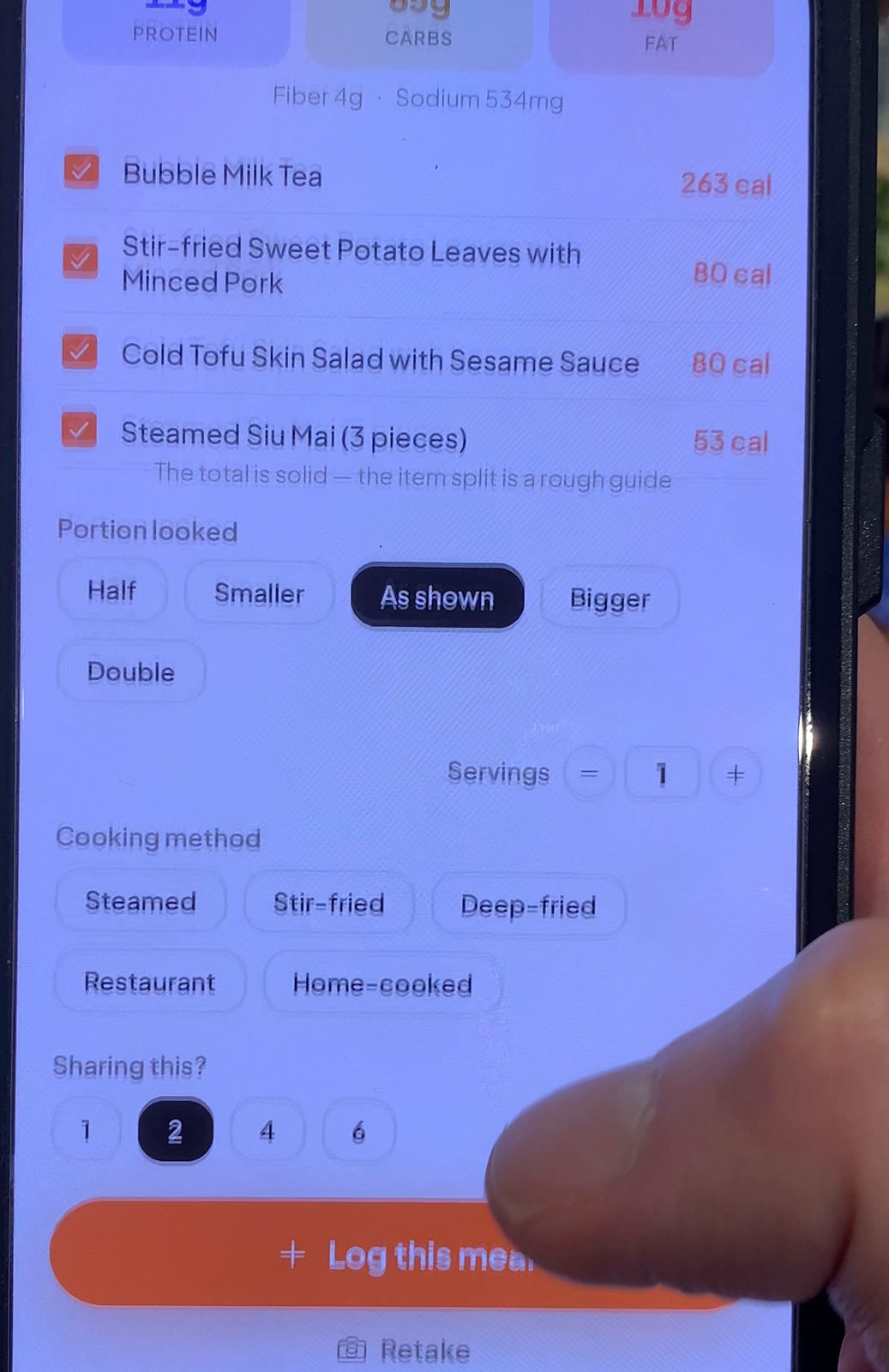
Bao's result screen with "Sharing this?" set to 2.
How Bao does it
Take one photo of the whole table. Bao reads every dish it can identify and shows the total. Then set how many people are sharing, and each row divides for you. You can still change the portion on any row if your share was not an even half. You never type a dish name or a weight.
The honest part: the app's own line under the list says it plainly. The total is solid — the item split is a rough guide. The whole-table number is the firmer one. The split into items is a guess about how a photo maps to dishes, so treat each row as a rough guide.
What the rounding means
Each row is divided and rounded on its own, so the halves may not add up to exactly half of the total. Here, 950 divided by 2 is 475, and the four rounded rows add up to 476. That one calorie is rounding, nothing more. The rounding is the only thing in this table that is allowed to be a little off.
Common questions
How do you count calories when you share food? Pick one rule before the food arrives and stick to it. The simplest is an even split by headcount: log the whole table once, divide by the number of people, and log your share. If you know you took more or less than your share, adjust the portion instead of the headcount.
Should I split calories evenly or by what I actually ate? Split by what you actually ate when you can remember it, and split evenly when you cannot. Even is a fair guess for dishes everyone picks at. For a drink that only one person finished, log it to that person.
Why don't the split numbers add up exactly? Each row is divided and rounded on its own. In the table above, 950 divided by 2 is 475, while the four rounded halves add up to 476. The difference is rounding, not an error.
Share the table, not the guesswork
Photograph the whole table once, set how many people are sharing, and let each row divide.
Download on the App Store