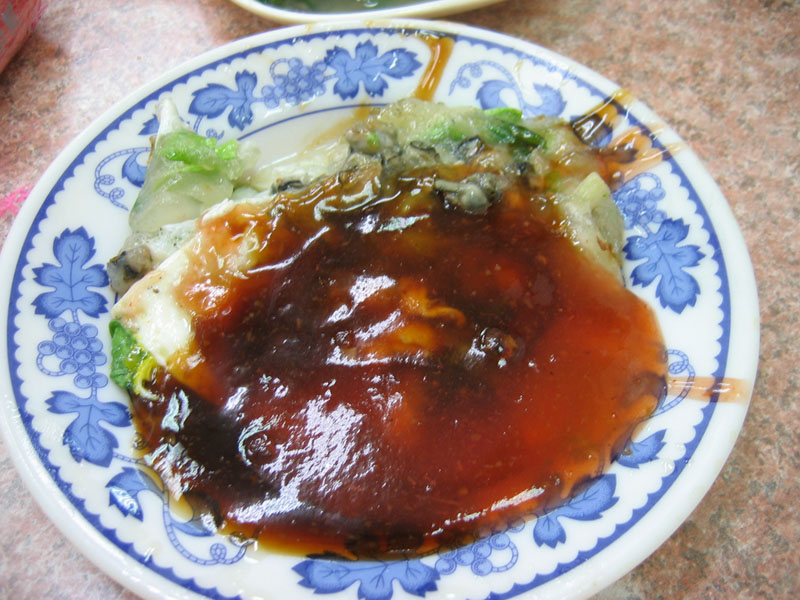
How Many Calories Are in 蚵仔煎 (Taiwanese Oyster Omelette)?
蚵仔煎 (ô-á-chian) is a night-market fixture: fresh oysters and egg folded into a sweet-potato starch slurry, pan-fried until the edges crisp up and the center stays slightly gelatinous, topped with leafy greens and a sweet-savory sauce (甜辣醬 or 海山醬). The English name — "oyster omelette" — suggests an egg dish. It isn't, really. The starch batter is doing most of the nutritional work, not the egg.
Standard serving (one plate, ~250–300g)
| Nutrient | Amount | % Daily Value |
|---|---|---|
| Calories | 460–560 kcal | 23–28% |
| Protein | 18–26g | 36–52% |
| Carbohydrates | 35–48g | 13–17% |
| Fat | 22–30g | 28–38% |
| Sodium | 750–1000mg | 33–43% |
The starch batter is the real calorie driver — not the oysters
Oysters themselves are lean — mostly protein, very little fat. A standard scoop of oysters on its own is roughly 60–80 kcal. What pushes the whole plate into the 500-kcal range is the sweet-potato starch slurry, pan-fried in a generous pool of oil to get that signature crisp-edge, gooey-center texture, plus a sugar-forward sauce drizzled on top.
"More oysters, less batter" plates run lower-calorie. Cheaper or high-volume stalls sometimes go the other way — more starch slurry, fewer oysters — which pushes a plate toward the top of the range.
Why other apps get this wrong
Generic calorie trackers see "egg" and "seafood" and log it as a light, protein-forward omelette. That misses the starch slurry base entirely — the batter and sauce combined usually outweigh the egg and oysters put together.
How Bao handles it
Bao reads batter thickness and sauce coverage from the photo, rather than defaulting to a plain Western-omelette calorie baseline.
Common questions
How many calories are in 蚵仔煎 (oyster omelette)? One standard plate (about 250–300 g) is roughly 460–560 kcal. That is a typical-serving estimate, not an exact count. The oysters themselves are only about 60–80 kcal. What pushes the plate into the 500-kcal range is the sweet-potato starch batter, pan-fried in a generous pool of oil, plus a sugar-forward sauce.
Is oyster omelette high in protein? The page lists 18–26 g of protein for a standard plate. The oysters are lean, mostly protein with very little fat. The name suggests an egg dish, but the page says the starch batter is doing most of the nutritional work, not the egg. These are typical ranges, not a measured plate.
What changes the calories in an oyster omelette the most? The batter. "More oysters, less batter" plates run lower-calorie, while cheaper or high-volume stalls sometimes use more starch slurry and fewer oysters, which pushes a plate toward the top of the 460–560 kcal range. The sauce adds too. The name says omelette; the batter disagrees.
Are these oyster omelette numbers exact? No. 460–560 kcal is a typical range for one plate, and the batter and sauce change from stall to stall. Generic trackers often log it as a light omelette and miss the starch base. Bao reads batter thickness and sauce coverage from the photo instead of defaulting to a plain Western-omelette baseline.
Stop guessing your macros
Bao gives you honest nutrition estimates for the food you actually eat.
Download on the App Store