Hidden Calories in Restaurant Food: 3 Things a Photo Scan Catches
The things that move a restaurant meal's calorie count are almost never the things on the menu. The menu names the dish. It does not name the oil the dish absorbed, it does not know what you told a tracker about yourself last month, and it has no idea what you already ate today.
Below are three real examples, each from a single photo scan, of information that was on the plate the whole time and invisible to the person holding the fork.
1. The frying oil is its own line — 68 calories that aren't food
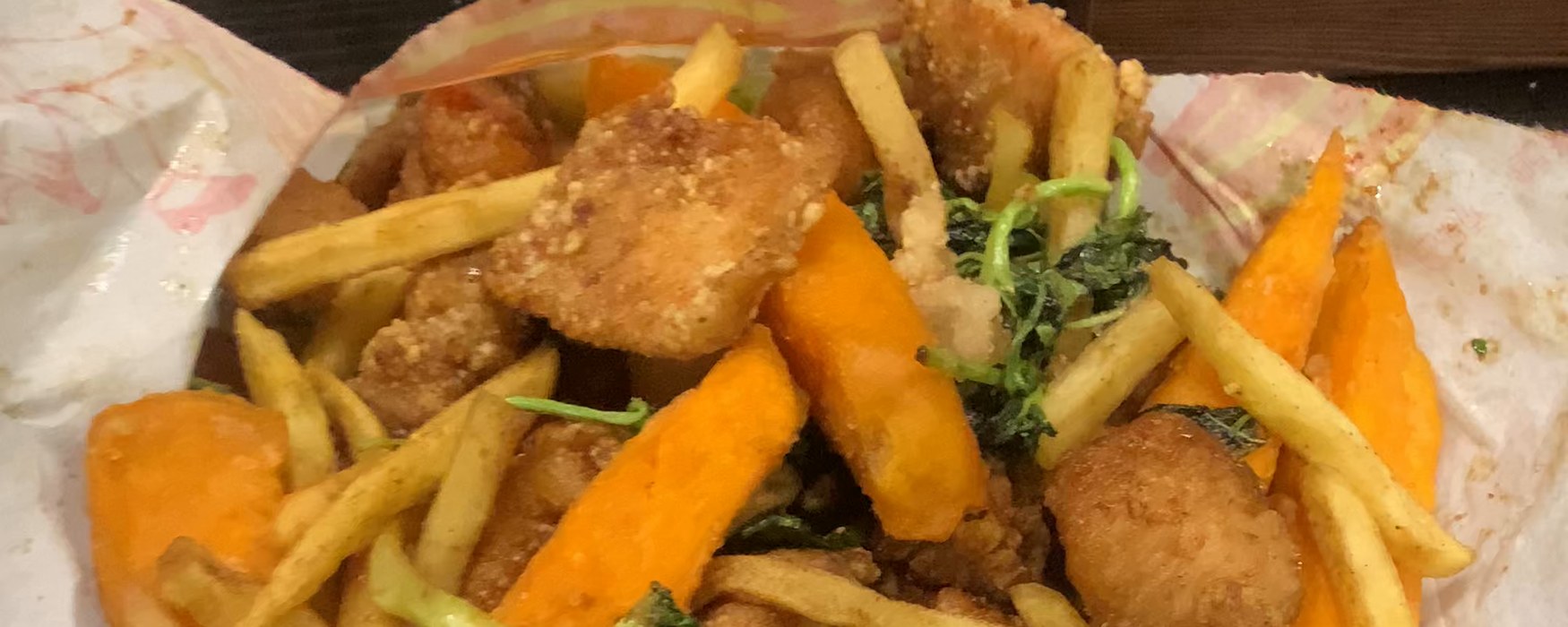
This is one fried chicken order, photographed once and itemized. It is not a plain portion of chicken: it came with sweet potato wedges, skin-on fries and a handful of fried broccoli in the same pile.
| Item | Calories |
|---|---|
| Fried chicken bites — approx. 6 pieces | 389 kcal |
| Sweet potato wedges (fried) — 4 wedges | 259 kcal |
| French fries (skin-on) — medium handful | 238 kcal |
| Frying oil / batter residue (added fat from deep-frying) | 68 kcal |
| Fried broccoli florets — a few pieces | 65 kcal |
| Wheat-containing batter/wrap (gluten) — present in fried coatings | 0 kcal |
| Total | 1,019 kcal |
The scan also returned 33g protein, 100g carbohydrate, 52g fat, 10g fiber and about 1,200mg sodium. AI estimates from one photo, not lab measurements.
The line worth staring at is the fourth one. Frying oil is not an ingredient anybody orders, and it is not on any menu — it is what the food was cooked in, and it still carries 68 calories into the total. Nobody writes that down, because there is nothing to write down: it has no packaging, no portion and no name until something gives it one.
Why the total is higher than a plain portion: a standard bag of fried chicken on its own runs roughly 490 to 610 calories. This order is past a thousand because three fried side items were in the same pile. The chicken was never the whole story.
2. No label, no packaging — and a flag anyway
The second scan is a poke bowl at 550 calories: soba noodles, salmon, tuna, seaweed salad, tofu, sesame, broccoli, cherry tomatoes. Assembled at a counter, served in a ceramic bowl, no packaging and no label anywhere in the transaction.
The scan came back with the itemization and with a flag: a heads-up that the bowl was likely high in potassium, phosphorus and sodium, and that this was something the person had previously entered into their own profile as a concern.
That is worth separating into two facts, because only one of them is about food. The first is that a bowl with no label still has a composition. The second is that a note entered once, weeks earlier, was still being applied — the scan was reading the eater as well as the meal. Neither of those is visible in the bowl. This is not medical advice and no app should give any; it is a reminder attached to something you already said about yourself.
3. The day already had lunch on it
The third catch has nothing to do with the plate at all.
A dinner gets scanned at a counter. Before it is even logged, the day's ledger already reads 1,011 calories of 2,161 — and 450 of that is a bowl of pho logged hours earlier and long forgotten by the person now ordering.
Every dinner decision people make at a counter is made against a budget they are estimating from memory, and memory is generous. The number that actually matters at the moment of ordering is not the dish's calories — it is what is left. That figure cannot be read off a menu, a plate, or a label. It only exists if something has been keeping count since breakfast.
What the three have in common
| The catch | Where it hides |
|---|---|
| 68 kcal of frying oil | Inside the cooking method, not the ingredient list |
| A profile flag on an unlabeled bowl | In something you said weeks ago, not on the food |
| 450 kcal already spent today | In the morning, not on the table |
None of the three is exotic. None requires a laboratory. All three are ordinary arithmetic that nobody does at a counter with a tray in one hand, which is exactly why they go uncounted — and why they are the difference between a number that is roughly right and a number that is quietly 200 calories light, several times a week.
Common questions
How much does cooking oil actually add? It depends far more on the method than the food. Deep-frying adds meaningfully more than pan-frying, and a thick batter in older oil absorbs more than a thin coating in fresh oil. The 68 calories above are for one order's residue — a heavily battered dish can carry several times that.
Should I be adding oil to everything I log? Not by hand, no — you would guess, and the guess would be worse than the omission. The useful version is a system that itemizes what it sees and shows you the line, so you can decide whether it looks right.
Are estimates like these accurate? They are estimates, and they say so. The value is not in the last digit — it is in the itemization. A single number for "fried chicken" tells you nothing you can act on; six lines tell you the sides were more than half the total.
Isn't tracking the day just as easy in my head? It is, until roughly 2pm. The ledger example above is the ordinary case, not an extreme one: one meal, six hours old, worth 450 calories, entirely absent from the decision being made.
How Bao handles it
One photo returns the meal broken into parts — including the parts nobody ordered, like the oil — alongside what the day has already spent. That combination is the point. An itemized plate tells you what is in front of you; a running day tells you what it costs. Neither is much use alone at the moment you are deciding what to order.
Stop guessing your macros
Bao gives you honest nutrition estimates for the food you're actually eating.
Download on the App Store